

Keeping your phone charged while camping, backpacking, or hiking is now easier than ever. You can charge your favorite small devices while on the go, giving you the ability to use your camera, maps, and other essential functions.
If you know how to do it right, you don’t have to spend a lot of money. And best of all, you can charge your phone for many days while away from home power.
This straightforward article goes over the best options, starting with small budget-friendly devices and working up to series solar generators. It doesn’t matter if you’re a thru hiker or are going for a long adventure, this article has a camp solar chargers that fits the bill.
We carefully select the products and services we link to. If you buy through our links, we may earn a commission. There’s no extra cost to you and it helps us provide this information.

Best Portable Charger for Camping, Backpacking, and Hiking
Let’s get right to it with the best portable chargers, solar chargers, and portable batteries for camping.
We’ll start with the lightweight option as the best solar panel for backpacking or hiking, then progressively get a little bigger, up to the best portable charger for camping in a tent.
Sleek and Portable Package: Hiluckey Solar Charger
If you want one small device that will charge your phone while camping, this Hiluckey Solar Charger takes the top spot. It combines a substantial battery bank with a built-in portable solar panel.
Together, you can get nearly endless phone charging anywhere you have sun.
The power bank is 27,000mAh (99Wh). In non-geek terms, that’s enough to charge your cell phone about ~8 times. With this small battery bank alone, you can go for a multi-day camping trip and not have to worry about charging your phone.
But if 8 charges isn’t enough, the integrated fold-out solar panel can help out.
Unlike other solar battery banks with a solar panel so small it’s worthless, this one has four decent sized panels. It generates up to 6W of energy. In 4 hours of peak sunlight, you can expect to generate around 20Wh of electricity while camping or hiking.
That means ~4 hours of sun can fully charge your phone AND charge the internal battery bank some.
Just know that solar power in reality might not match these ideal figures. If you really need solar power, get a dedicated solar panel as listed in the next section.
Quick Solar Charging on Adventures: Anker Power Bank + 40 W Solar Panels
Anker is one of the best brands for portable battery banks around. And this 26,800 mAh (96 Wh) power bank has everything you need to keep your phone charged while camping, backpacking, or hiking.
Like the Hiluckey power bank, this Anker option has enough juice to charge an average cell phone about 8 times. It can easily handle any needs for charging your phone while hiking. And it’ll do just fine for a weekend trip.
But you can transform this into a real solar powered charger by adding the FlexSolar 40W foldable solar panels. This is a small, affordable package that is amazing for charging small devices while camping.
For charging phones, 40W of solar is a great fit. With ~4 hours of peak sunlight per day, you can generate ~130Wh of energy (after a 20% inefficiency loss). That is enough to fully recharge this power bank, which has 96Wh. Phone batteries are usually around 10Wh, so it’s plenty for multiple charges of your phone.
This is a perfect package for charging phones while backpacking or any time you’re away from home for multiple days. It’s plenty of solar to get the job done, mixed with a battery pack that’s large enough too.

|
Anker 337 Power Bank (PowerCore 26K) |
Buy on Anker Buy on Amazon |
More Camping Electricity: EcoFlow River 2 Power Bank + 110 W Solar Panel
Many campers have jumped up to the world of solar generators. They’re a modern solution to bringing electricity while camping. You can easily charge your phone and run other electronics.
Light up your campsite. Charge your Bluetooth speaker. Run a portable refrigerator. Power an air pump for water toys. Bring a CPAP machine camping. Really, just about any small electronic device you want can come along for the adventure now.
A solar generator is a small device that lets you capture, store, and use energy.
It starts with a portable power station. These are like a portable battery bank on steroids. They have a built-in battery, plus a lot of outlets. Like the small battery banks, they can easily power USB devices. But these also have a power inverter, which means they have a 110 V AC outlet as well, the common household plug. It opens the door to all sorts of other electronics.
Once you have your power station, add a solar panel to it. Now you have a solar generator. You can read more about How Solar Generators work here.
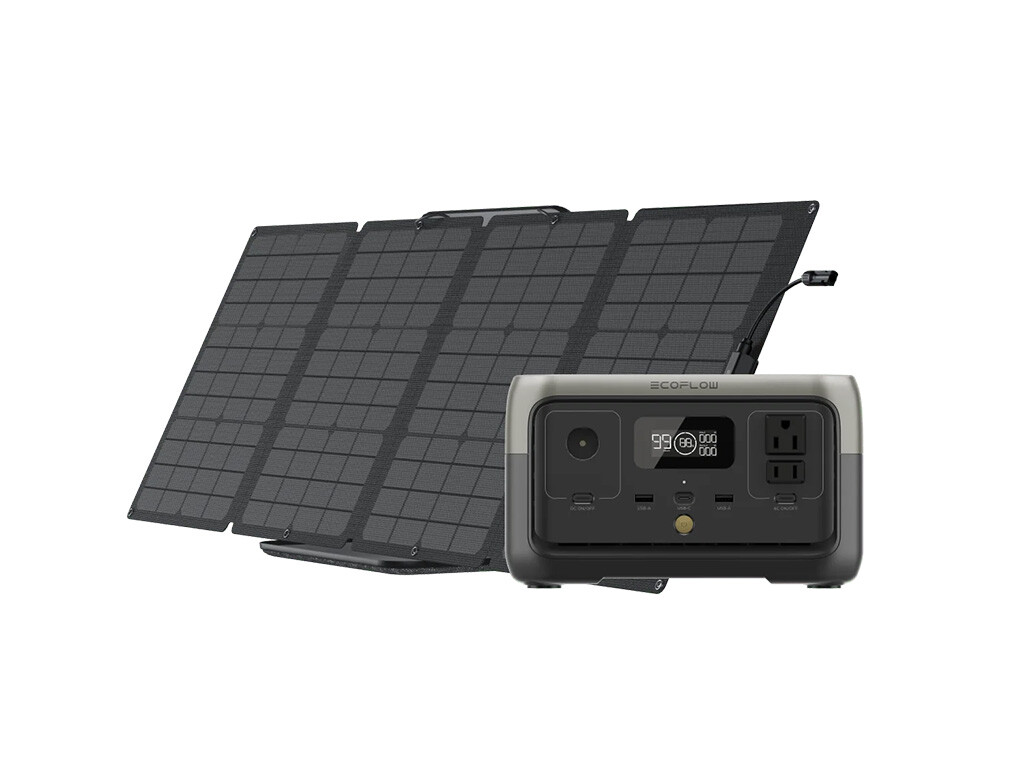
The best entry level solar generator is an EcoFlow River 2 Power Bank paired with a Portable 110W Solar Panel. This gives you 256Wh of battery storage, enough for 20 phone charges.
And with 110W solar panels in 4 hours of peak sunlight, you can add ~400Wh of energy each day! Enough to fully charge your EcoFlow River 2, many phones, and other devices.
|
EcoFlow RIVER 2 Solar Generator with 110W Portable Panel |
Buy on EcoFlow Buy on Amazon |
How to Charging Devices While Camping: Understanding It All
We’ve gone into the deep end first. Those three options are ideal and you really can’t go wrong with any of them. Whether you want a quick charge with a battery bank, an extremely lightweight solar system for backpacking, or a more robust tent camping solar generator, you can get your phone charged while camping.
But it may help to understand a little more about the electricity your phone needs and how these battery banks and solar panels provide that. Then you’ll really get the full picture about charging devices while camping, backpacking, or hiking.
Let’s look a little closer at each option and how solar charging works.
Portable Battery Banks
One of the best things to keep around is a portable battery bank. You can toss it in your camping gear or hiking backpack to supply a lot of power for your phone. They’re also great for long days away from home or outlets. Never have a dead phone again, even if you forget to charge it overnight.
What’s great about them is that many of them are:
- Compact and lightweight, typically around the size of two cell phones
- Packed with enough electrical power to charge a phone many times
- Amazingly easy to use with a simple input and at least one USB outlet for your phone
The downside is that they don’t actually generate any power. They also have relatively slow charging rates and they only have USB outlets.
Regardless, having a portable battery bank can really help explore. They’re great for cell phone charging while camping or on nearly any adventure. You can bring them on planes, buses, and just about anywhere in the world. You’ll never have to scrounge for an outlet again.
It also works really well just for shopping errands. You don’t have to worry about charging while driving. Just plug it into the battery bank, toss it in your bag, and your phone will charge anywhere you go. It can keep the whole family’s devices charged up.
But sometimes you need more power. And that’s where solar charging comes into play.
|
|
Anker 337 Power Bank (PowerCore 26K) |
Buy on Anker Buy on Amazon |
|
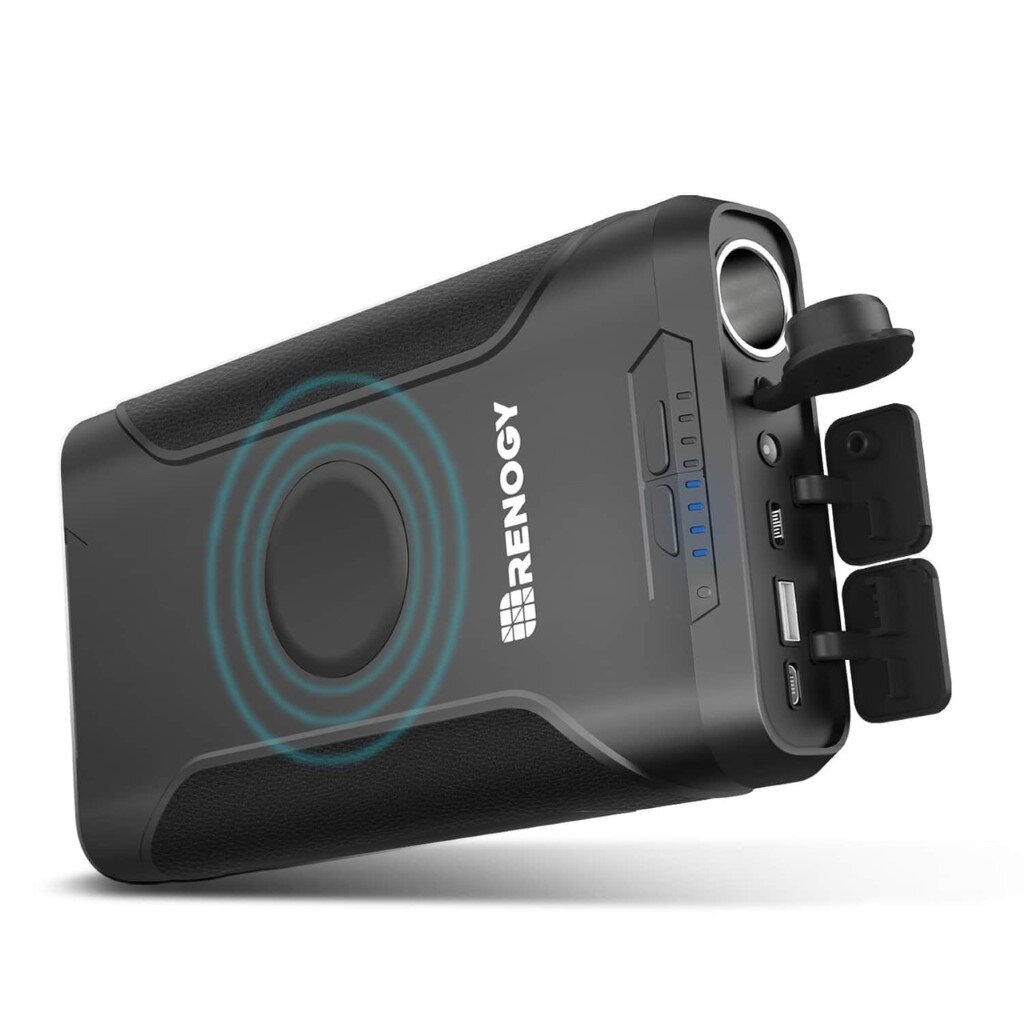
Renogy 72000mAh Power Bank With 60W Output |
Buy on Renogy Buy on Amazon |

|
Anker 737 Power Bank (PowerCore 26K for Laptop) |
Buy on Anker Buy on Amazon |

How Solar Charging Works
Solar power is a truly remarkable thing. These special panels absorb the sun’s energy, which causes a bunch of electronics to start bouncing around. These bouncing electrons are captured and sent through a wire as the output from a solar panel. That’s the basics of solar energy.
To use solar power while camping, pair the solar panels with a battery pack. This lets you charge up the battery quickly while the sun is at its peak. Then you can use the battery pack during the other hours when the sun is too low and during night.
Solar panels are rated in Watts (W). This is the flow of electricity that comes off of them during peak sunlight. It’s not stored. It’s just flowing out like a faucet turned on.
Batteries are rated in Watt-hours (Wh), which is the amount of energy stored. It’s like putting a bucket under the energy flowing from the solar panel faucet.
To know how much energy your solar panel creates, just take its Watts and multiply it by the number of peak sunlight hours.
Say you have a 100W solar panel. In ideal conditions, if you set it in direct sunlight for one hour, you will generate 100Wh of energy. The only problem is that reality isn’t ideal. You should actually plan on about 80% of its Watt rating. And peak sunlight usually lasts only about 4 to 6 hours (on clear days).
This means a 100W solar panel will:
- Generate about 80W per hour in reality, not 100W
- Only absorb the sun’s peak energy for about 4 hours per day (if it’s not cloudy)
- 80W times 4 hours generates 320Wh of energy per day
What does that mean for your devices?
Devices are also measured in Watts and Watt-hours. It’s easiest to think of phones as batteries only. Then you’re just looking at Watt-hours.
Many phones store around 10Wh of electricity in the battery. So based on that 320Wh coming off that 100 W solar panel, you can charge a phone over 30 times! Pretty amazing.
Just remember, solar panels won’t really give you the full power they say they are. And charging will also have some loss too. You feel it as heat in the connections and wires. So that 320Wh will probably be a little less than 30 charges.
But this is how to understand solar for camping and all other needs.

|
Renogy 100W Portable Solar Panel |
Buy on Renogy Buy on Amazon |

|
EcoFlow 60W Portable Solar Panel |
Buy on EcoFlow Buy on Amazon |

|
BLUETTI 120W Portable Solar Panel |
Buy on Bluetti Buy on Amazon |

Solar Chargers and Generators
Now that you have the basics of solar power down, bring that back to reality with solar chargers and generators.
The Hiluckey Solar Charger has a 99Wh battery pack, enough for up to 10 phone charges. But it also comes with a 6W solar panel. This 6W panel is likely to produce about 19Wh of electricity per day (80% for 4 hours). That is still two full phone charges!
Once again though, these are still pretty close to ideal situations. That’s why it’s useful to get a larger solar panel and larger battery than you imagine.
The EcoFlow River 2 gives you a much more impressive 256Wh of battery storage. If you are camping where bringing along a larger device is easy, it’s well worth the extra space.
And on top of that, the technology within this solar generator is much more sophisticated. It will be able to handle a lot more charging from solar panels. It also has an inverter which makes it so you can use a normal 110V/120V household outlet.
The inverter is a crucial element and one of the most expensive parts of any solar generator. It is rated in Watts, which is the amount of electricity that can flow out of it at once. The River 2 is an entry-level model with a 300W inverter. This is enough for many small devices, like fans and laptops.
But if you want to power a large blender, a microwave, or another more energy-intensive device, you need a solar generator with a larger power inverter. These will also come with a larger battery bank.
For example, the EcoFlow River 2 Pro has 768Wh of battery storage. A serious improvement that can even be a decent amount for home backup power. And the inverter jumps up to 800W. It’s still a relatively small inverter, but it’ll handle a lot more devices.
If you really want some portable power, the EcoFlow Delta series is where you want to look. You can get serious battery storage and powerful inverters.
The Bluetti AC200MAX provides a lot more power that will make sure to run your refrigerator, lights, and basically any small appliance you could dream of. You could even run a portable air conditioner with it.
These devices are not only an investment in your camping gear, they also give you a backup energy system you can use at home or anywhere else. No more worries about power outages. Go anywhere for any event and bring your electronics along for the ride.

|
EcoFlow RIVER 2 Pro |
R2P on EcoFlow R2P on Amazon |

Camping Stove That Charges Phone
You may have seen a camping stove that charges a phone. The best one is the BioLite CampStove 2. It transforms the wood burning energy into USB charging for your phone.
While the idea of using wood to fuel your phone sounds great, it’s quite challenging in reality.
The maximum electrical flow is just 3W. To generate enough power to charge a phone, you need to have this burning for about 3 to 5 hours. And even then, this 3W rating is the maximum. You’ll likely see a lower rate in reality.
While these will turn wood burning into phone-charging electricity, it will be quite limited. A 3W solar panel would be considered worthless. You want about 40W at minimum to charge a phone and a battery bank.
This device is a great way to squeeze electricity out of your wood fire. But it’s a bit of a stretch to depend on it for any meaningful charge. You’re better off using a portable battery pack and a 40W solar panel if you want to be serious about charging your phone while camping or backpacking.
Charging Your Phone While Camping: Wrap Up
Keeping your phone charged while camping is easy. Whether you’re good with a small portable battery bank or want to get one of the best solar generators, there’s a way to charge all of your devices. And you can even get a way to have some backup power for errands or when the power goes out.
There’s no reason to wait. Order your camping power source today and be ready for your next adventure.
To learn more about how to keep devices charged up while in wilderness, head over to our post on Bringing Electricity While Tent Camping or Adding Solar Power to an RV or Van.


